



The transition from education into employment is one of the most consequential and fragile points in a disabled person’s life. For many young people, it marks a shift from structured educational support to self-advocacy, from entitlement-based frameworks to a performance-driven labour market. When this transition is poorly coordinated, it can entrench disadvantage. When supported coherently, such transitions can unlock confidence, independence, and sustained economic participation.

Source: Pexels
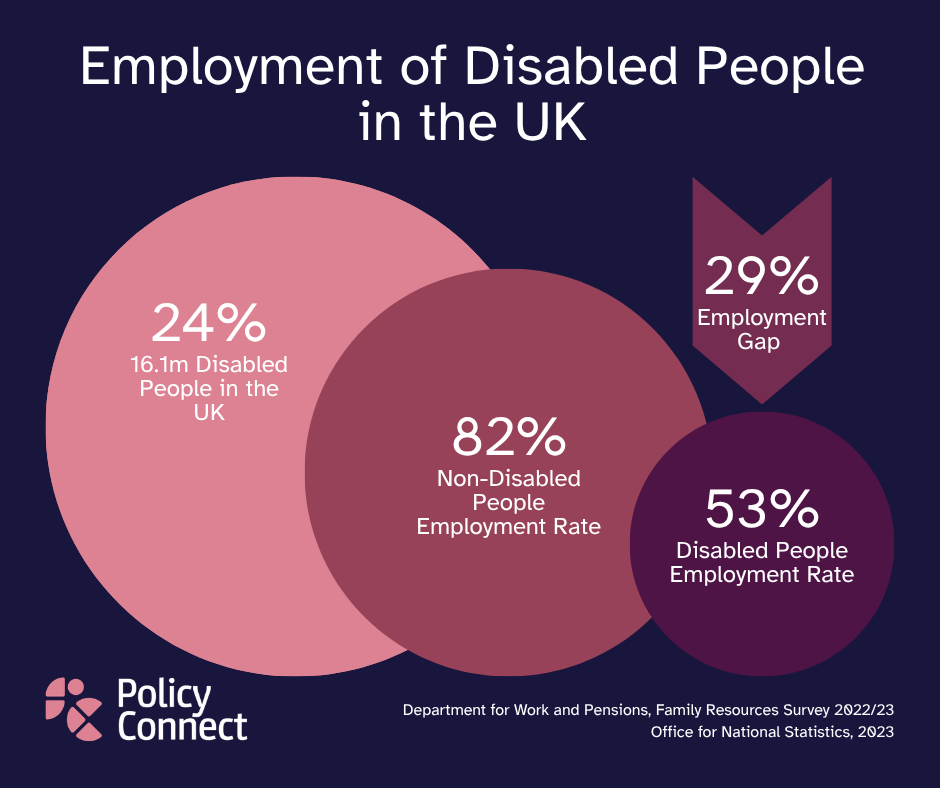
Despite years of reform, the disability employment gap remains substantial. In the UK, 16.1 million people are disabled, representing around 24% of the population. Nevertheless, in 2025 the employment rate for disabled people was 52.8%, compared to 82.5% for non-disabled people, a gap of 29.7 percentage points. For many young disabled people, this gap emerges at the point of transition, when school-based support ends and labour market expectations begin. This gap represents not only social injustice but foregone productivity, reduced tax contribution, and increased fiscal pressure.
ATech has the potential to change this trajectory. However, its impact depends on how and when it is used. When introduced only after barriers arise, it acts as a reactive adjustment. When embedded early and used consistently, it becomes part of mainstream capability development. Narrowing the employment gap therefore requires a shift in perspective, from occasional intervention to embedding ATech across the education-to-employment journey.
Early Childhood: Building Capability from the Start
Employment outcomes are influenced long before a first job application is submitted. Early childhood is where communication skills, confidence and independence begin to develop. Research consistently shows that early exposure to assistive communication tools improves participation, language acquisition and social engagement. These early gains accumulate over time, shaping attainment, aspirations and resilience.
In the UK, the growing number of children identified with special educational needs and disabilities reflects increasing demand for structured support. Education, Health and Care Plans have doubled since 2015, and local authority SEND spending has risen sharply over the same period. This expansion reflects both greater recognition of need and mounting pressure within the system. Indeed, demand for assistive products is rising globally. The World Health Organisation estimates that 2.5 billion people currently require at least one assistive product, with this figure projected to rise to 3.5 billion by 2050.
Embedding ATech in early years settings should not be viewed solely through an inclusion lens. It also represents economic foresight. When children develop digital confidence and adaptive strategies early, they enter later stages of education better equipped to navigate complexity. Accessibility tools integrated into everyday learning become part of a child’s cognitive toolkit. In contrast, when technology is accessed only through contested funding processes, it risks reinforcing dependency rather than supporting independence.
School Years: From Adjustment to Digital Fluency
As pupils progress through primary and secondary education, the role of ATech should evolve from enabling access content to building transferable skills. Rather than being used solely to overcome immediate barriers, accessibility tools should support independence, organisation and digital fluency that can be applied beyond the classroom. Many accessibility features are now embedded within mainstream operating systems and educational platforms. Speech recognition, live captioning, screen readers, visual adjustments and organisational supports are widely available and often free. Yet the presence of tools does not guarantee effective use.
The key challenge at this stage is normalisation. When accessibility features are routinely used by teachers and pupils, they become part of everyday digital literacy. When activated only under formal arrangements, they can feel exceptional or stigmatising. Evidence suggests that teacher confidence in assistive technology remains uneven, and training coverage varies across regions and institutions. This inconsistency produces postcode variation in digital inclusion and, by extension, in employment readiness.
The SEND system has also faced increasing strain. Rising EHCP numbers and associated funding pressures have intensified disputes over thresholds and entitlements. In this context, ATech can be mischaracterised as an additional cost rather than a long-term investment. A reframing is required. Technology that builds independence during school years can reduce the need for later interventions and strengthen transition readiness. It should therefore be seen as part of mainstream education strategy, not an add on.
Further Education and Supported Internships: Bridging Education and Work
The transition to further education, supported internships and employment support programmes provides a bridge between structured learning and the labour market. Supported Internships combine classroom study with sustained workplace placements for young people aged 16 to 24 with an EHCP. Connect to Work and related programmes seek to reduce economic inactivity among disabled people and those with health conditions. These initiatives reflect recognition that structured transition pathways are essential.
However, this stage often reveals a lack of alignment between education, employment and support systems. Educational frameworks operate under one set of rules, while employment systems operate under another. Funding streams shift, eligibility criteria change and responsibilities move between departments. For young people navigating this transition can feel abrupt rather than continuous.
Access to Work plays a crucial role in funding workplace adjustments, including assistive technology. In 2023/24, the scheme supported nearly 68,000 people. Yet relative to the size of the disabled population and the scale of the employment gap, this represents only part of potential need. Application timelines and assessment processes can also delay support, particularly in the early stages of employment or placement. When assistance arrives after confidence has already been undermined, its impact is diminished.
Free ATech provides a practical bridge. Built-in accessibility tools can be introduced immediately during supported internships and employment coaching. Job coaches can demonstrate speech-to-text for CV preparation, accessibility settings for job search platforms and captioning tools for interviews. While not a substitute for specialist equipment, these tools provide continuity and portability. They enable young people to practise work with technology that follows them into employment, transforming ATech from reactive adjustment to proactive capability.
Key Programmes and Organisations Supporting Employment and ATech
Early Career: Retention, Productivity and Workplace Culture
Entry into employment does not eliminate structural barriers. Rather, it often exposes them. Retention and progression depend on workplace culture, system design and leadership commitment as much as on individual skill. Employers frequently cite cost and complexity as barriers to implementing adjustments. However, evidence from UK employers and employees indicates that many workplace adjustments are low cost and deliver clear benefits in productivity and retention.
Inclusive design benefits organisations broadly. Systems that offer flexible interfaces, captioning, clear navigation and adjustable settings improve usability for all staff. When accessibility is built into core digital infrastructure from the start, it supports efficiency rather than adding administrative burden.
Normalising ATech use before employment supports this cultural shift. If individuals arrive in workplaces already fluent in accessibility tools, conversations move from entitlement to optimisation. Adjustments become about enabling performance rather than compensating for deficit. This shift may appear subtle, but its impact on retention and progression can be significant.
Employer Frameworks and Support for Workplace Accessibility
Later Working Life: Sustaining Participation
A serious employment strategy must also account for change over time. Disability is not static, and working lives are lengthening. Health conditions fluctuate, impairments can emerge later in life, and career paths evolve. Assistive technology therefore plays a role not only in facilitating entry into work but in sustaining participation across decades.
Digital exclusion remains persistent in the UK. Millions of adults have low digital capability or limited access to online services. For disabled people, digital barriers often intersect with financial exclusion and reduced access to public services. Accessible digital banking, HR platforms and government services are essential to maintaining independence and labour market engagement.
Embedding accessibility throughout working life reduces the risk of avoidable economic inactivity. It aligns with broader policy goals around extending working lives, improving productivity and supporting fiscal sustainability. When viewed through this lens, ATech becomes part of economic resilience rather than simply disability accommodation.
Sustaining Participation and Digital Inclusion
From Fragmentation to Alignment: A Policy Imperative
The current system too often treats transition as a series of disconnected stages. Educational support ends, employment expectations begin, and technology is accessed through separate funding channels. This fragmentation creates friction and reinforces dependency rather than independence.
A more effective model would treat accessibility as cumulative. Early exposure builds confidence, routine use builds fluency, and consistent integration builds independence. When carried into the workplace, this foundation supports retention and progression. Workplace integration strengthens retention. Such a model requires alignment across education reform, employment support, digital inclusion strategy and workplace regulation.
Embedding ATech into practice requires closer collaboration between education providers, employment services and employers. This could include partnerships between employers and specialist schools or colleges, enabling young people to develop and apply accessibility skills in real workplace contexts before entering employment. Aligning programmes such as Access to Work with earlier digital skills development would ensure continuity of support, while measuring success through retention and progression, rather than placements alone, would better reflect sustainable employment outcomes.
The disability employment gap reflects accumulated disadvantage across multiple stages of life. Assistive technology alone cannot eliminate structural inequality. However, when used consistently across childhood, education and employment, it can strengthen independence and opportunity.
Conclusion: Infrastructure for Participation
Assistive technology should not be viewed as an emergency response or specialist add-on. It should be understood as infrastructure for participation. When embedded across the journey from early education to early career and beyond, it can make transitions smoother and strengthen long-term economic engagement.
Closing the disability employment gap requires moving beyond episodic adjustments towards systemic embedding. Early exposure, workforce capability, employer engagement and policy alignment must operate together. For transitions to feel like a bridge rather than a cliff edge, ATech must be present not only at the moment of employment but throughout the pathway leading to it.
Key Organisations and Frameworks Across the Education-to-Employment Continuum
 Related content