


Why Numeracy is the Foundation of AI Readiness: Emerging Findings on AI, Numeracy and Social Mobility
When the government published its AI Opportunities Action Plan in January 2025, the focus was on accelerated rollout, global competitiveness, and productivity gains. In the period since, public debate has been shaped by the rapid proliferation of large language models and accessible AI chatbots, and the ethical questions these have raised around bias, transparency, and responsible deployment. What has received comparatively less attention is the question of how we prepare people, practically and equitably, for an AI-enabled world.
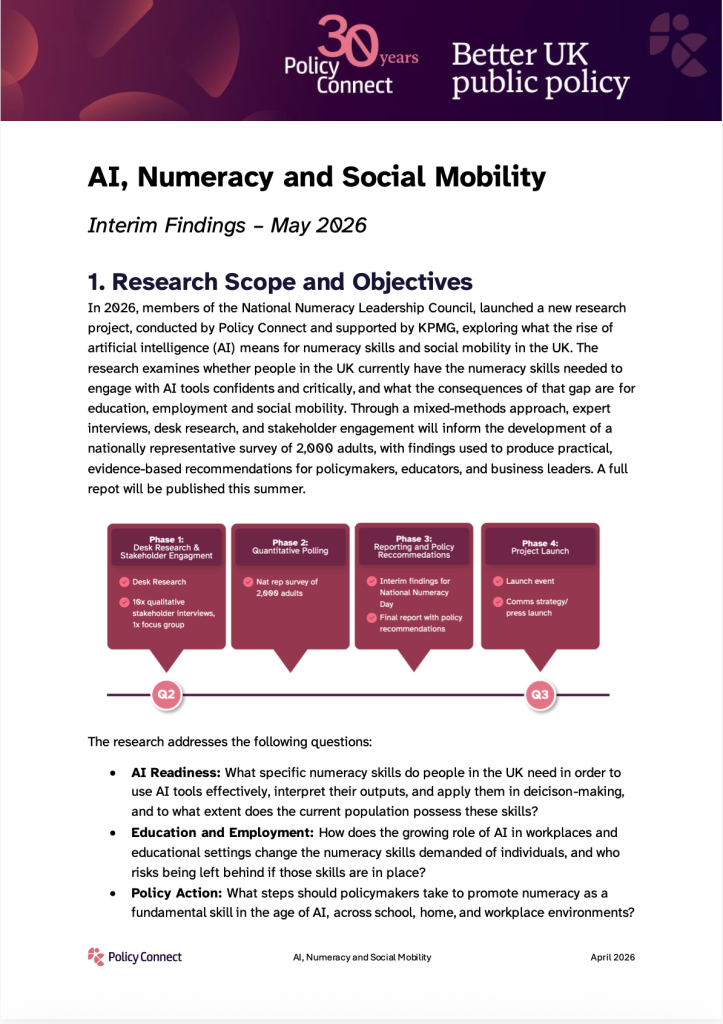
It is against this backdrop members of the National Numeracy Leadership Council, published an interim report of the research, conducted by Policy Connect and supported by KPMG, exploring what the rise of artificial intelligence (AI) means for numeracy skills and social mobility in the UK. Drawing on stakeholder interviews, desk research, and initial insights from our quantitative polling, what follows reflects the emerging picture from the first phase of the work.
Potential benefits are outweighed by concerns over output reliability
Stakeholders across our interviews have been broadly positive about what AI tools could offer. They point to the speed at which these tools can handle complex tasks, their potential to make information more accessible, and their capacity to support people who may lack confidence performing certain tasks independently, including numerical ones.
But stakeholders were equally consistent in raising concerns. AI tools can present information as though it is accurate and complete, regardless of whether it is. They do not reliably signal uncertainty, and outputs tend to be confirmatory, reinforcing what a user already believes rather than challenging it. The quality of a response depends significantly on how a question is framed, and many models are trained on datasets that carry their own flaws, including documented examples of racial bias.
Critical thinking is the essential skill, and it requires numeracy
Given these reliability concerns, stakeholders consistently identified critical thinking as the most important capability for meaningful AI engagement: the ability to assess whether an output is reasonable, to sense-check it, and to recognise when something may be wrong.
What emerged strongly from the research is that this kind of critical thinking is grounded in numeracy. Even where a question appears qualitative, AI tools draw on probability and statistical inference. Recognising when a figure, proportion, or numerical claim warrants scrutiny requires a basic understanding of scale, units, patterns, and statistics. Without that grounding, users may not know what they are not checking.
The two groups most at risk
Our research identifies two groups who may be particularly at risk, both of whom are more likely to be drawn from those already experiencing disadvantage.
The first engages with AI tools but lacks the numerical grounding to assess what they produce, accepting outputs at face value across consequential contexts including financial decisions, health information, and educational support. The second disengages from AI altogether: the same opacity that produces uncritical reliance in some users generates avoidance in others, with growing consequences as AI becomes more embedded in working and everyday life.
Access is a further dimension. Reliable internet, appropriate devices, and the means to use paid platforms are unevenly distributed in ways that reflect existing socioeconomic inequalities. But stakeholders were clear that expanding access without building the skills to use tools critically risks deepening, rather than closing, the gap.
The pace of education is slower than that of AI
Stakeholders were broadly in agreement that neither formal education nor workplace training is adequately preparing people to engage with AI. Curricula are evolving too slowly relative to the pace at which the tools are developing. School maths provision, while valuable in some respects, may not be well suited to the kind of applied numerical reasoning that AI engagement requires. Many teachers have not yet had the time or support to develop familiarity with the tools at the pace their students are already adopting them. Employers, particularly smaller businesses, often lack the capacity to invest in AI literacy in any structured way.
So what does this mean for policymakers?
Three things stand out from the emerging findings.
First, the pace of policy is not keeping pace with AI development. Stakeholders felt that government has tended to focus on productivity and economic opportunity rather than on the foundational skills and preparation needed to make those gains broadly accessible.
Second, numeracy must be central to the conversation on AI readiness. Government frameworks have tended to treat numerical understanding as an assumed background competency, grouping it under broader categories such as digital literacy or STEM. If people are to be equipped not just to use AI tools but to question and evaluate what those tools produce, numeracy needs to be recognised explicitly as a core component of AI readiness.
Third, individual responsibility is not enough. The response to these challenges cannot rest solely on equipping individuals to engage more critically and effectively. Technology companies have a parallel responsibility to improve the transparency and accuracy of their tools, including more consistent flagging of uncertainty, errors, and limitations. Placing the entire burden of critical assessment on the individual user is neither sustainable nor equitable, particularly given that the skills required are unevenly distributed and, as the emerging findings suggest, not being adequately developed through existing provision.
The full report, including the results of our quantitative polling and final policy recommendations, will be published this summer.
 Download report