

 Accessibility
“There should be a unified complaints service to ensure that systematic issues are identified and addressed. There needs to be a revival of transport accessibility legislation to see how it can be streamlined, clarified and updated.”
– Ruth Cadbury MP, Chair of the House of Commons Transport Select Committee
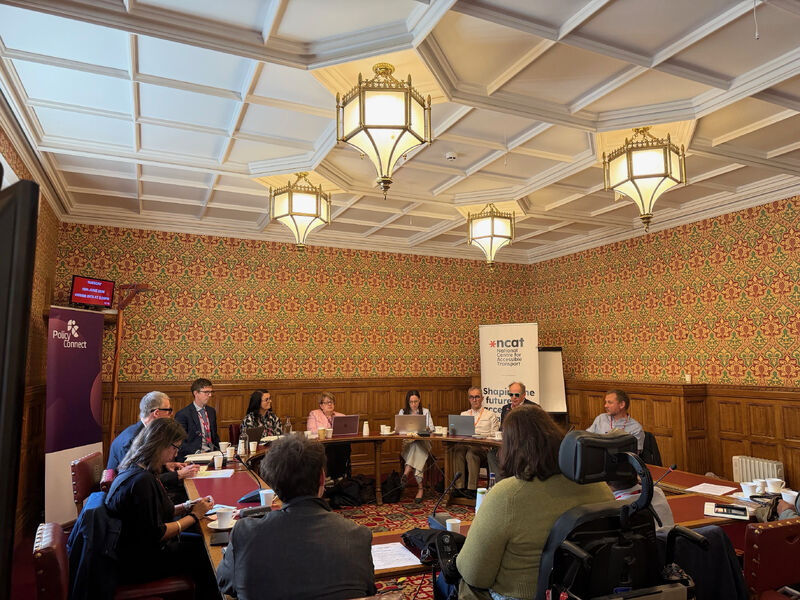
In June, the Accessible Transport Policy Commission hosted a hybrid roundtable on disabled people’s legal right to transport. The roundtable was chaired by Baroness Tanni Grey-Thompson, and reflected the Transport Select Committee’s Access Denied report, the Equality and Human Rights Commission’s Guiding Principles for Accessible Transport; and aimed to support the Law Commission’s review of transport accessibility legislation in England and Wales, which is commissioned by the UK Government.
This summary reflects the key findings from the discussion and only contains information and views shared during the event.
Fragmented, outdated, and unstable legislative framework.
The legal framework governing disabled people’s transport rights is outdated and divided across various laws and bodies. Particularly, it is split between the Equality Act 2010, retained EU law, sector-specific legislation (some dating back 30 years), and international human rights treaties. There is no single body that takes overarching responsibility.
Existing rights are currently at risk due to political debates, negative rhetoric about disabled people, and proposed changes to Personal Independence Payment and individual mobility schemes.
Outside of disability-specific policy decisions, such as low-traffic neighbourhoods and NHS car parking charges, disabled people’s transport rights can often be neglected altogether.
In order to establish and sustain disabled people’s rights, the work must happen across a variety of policy areas, such as health, welfare, clean air, and housing, and government departments.
“We would really encourage the Law Commission to use the Convention on the Rights of People with Disabilities as an overarching lens: to think about transport not just as a right in itself, but also as an enabling right that enables people to access other things like health services, education, employment and participation in the life of the wider community.”
– Dr Mary Ann Stephenson, Chair at the Equality and Human Rights Commission
(Inconsistent) enforcement of disabled people’s right to transport.
Regulators simply do not have enough teeth. The Transport Select Committee advocated for enforceable statutory duties to replace current vague language such as “having regard to”. The regulatory framework must clearly define operators’ responsibilities and give regulators the powers to enforce disabled people’s right to transport.
Lack of regulatory powers often puts disabled people in the position to self-advocate and risk being seen as the “problem” by operators. While victimisation is illegal under the Equality Act, this does not mean disabled people are safe from awkward and hostile situations after making complaints.
Regulators can sometimes avoid difficult cases and prioritise attention grabbing and easier cases. This limits the impact of their interventions and leaves disabled people alone to fight the more complex cases – if they can afford the expensive legal fees.
Monitoring methods are another barrier to protecting disabled people’s rights. Equality Impact Assessment can be biased, with assessors avoiding damaging client relationships. And worse, as EHRC highlighted, these assessments sometimes do not happen at all. Data used to monitor compliance is also flawed, as it favours those who can travel, younger people, and those with access to digital devices. Available data is also not accessible to everyone, as data ownership is fragmented and communication routes are limited.
(Lack of) up-to-date design, delivery, and training standards.
Design, delivery, and training standards are essential for equal rights. Current standards are generally outdated by 20-30 years, or they do not exist at all. Without standards, innovation attempts risk undoing progress made towards accessibility. Some examples of insufficient standards include the outdated infrastructure and vehicle standards that do not accommodate the diversity of disabled people, and blanket bans on mobility scooters. With the climate emergency we are in, there is also an increased need for standards around weather protection and improved emergency evacuation planning – a point made during yet another heatwave.
Human interactions are core to disabled people’s experiences of, and access to, transport. Not all operators know what is best practice, which can put disabled people and transport staff at opposing sides. When staff become the face of blame, as the only point of immediate contact, they can become frustrated and defensive. And when passenger assistance is used as punishment for staff members, it makes interactions with disabled people a chore. Transport operators must receive good quality training across the country to ensure disabled people’s are protected.
Standards must be open to modernisation, go beyond the bare minimum, and be coproduced with disabled people. It is the government and the industry’s responsibility to actively seek the experience and expertise of disabled people, and the regulators’ responsibility to encourage operators to aim for best practice.
Intersectionality: Recognising the diversity of disabled people.
The transport system largely views wheelchair users as the disabled community as a whole. However, people can be disabled in a variety of ways, with a variety of access needs. From the bans on mobility scooters to excluding autism from factors that qualify for concessionary travel, the reductionism directly harms disabled people. The review of disabled people’s legal rights must take an intersectional approach, even within “disability categories.”
Intersectionality, of course, goes beyond disabled identities. Disabled people’s experiences while travelling are also impacted by their intersecting social identities, including their race, gender, age, class, sexuality, religion, and cultural background. For instance, Black disabled women may avoid asserting their rights in wheelchair spaces to avoid racist tropes. Social identities are often protected characteristics that come with further rights which must be considered in discussions around legal right to transport.
“We hear about particular experiences of disabled women who face sexual abuse and harassment, particularly wheelchair users and visually impaired users. We hear that people with multiple disabilities have a different experience. the visually impaired wheelchair user who is required to put their wheelchair in front of the sign and audio equipment they need.”
– Connor Johnston, Senior Lawyer at the Law Commission
What next?
The Law Commission and the EHRC are seeking views on their respective work on disabled people’s right to transport. You may wish to get in touch with them directly or with Policy Connect to get involved in these consultations.
As the National Centre for Accessible Transport (ncat), we will continue our engagement with the governments across the UK to work towards equitable access to transport for all disabled people. The Accessible Transport Policy Commission will continue to meet around similar issues. For more information or to get involved, please contact Gurur Deniz Uyanik.


 Related content