


Over the past two months, Policy Connect has attended the 2026 Liberal Democrat, Labour and Conservative Party Conferences. Across the three conferences, we hosted five events spanning Accessibility, Education and Skills, and Health policy.
Each discussion brought together parliamentarians, policymakers, sector experts, practitioners and people with lived experience to examine some of the most pressing challenges facing government and public services. Below, we highlight the key themes that emerged from each event and reflect on how these conversations will inform our work over the year ahead.
Liberal Democrat Conference: Building a More Accessible Transport System for Disabled People
On 20 September, Policy Connect hosted Building a More Accessible Transport System for Disabled People at the Liberal Democrat Party Conference in Brighton.
Chaired by Steff Aquarone MP, a member of the Transport Select Committee, the panel brought together Dr Emma Partlow, Chief Executive of the national centre for accessible transport (ncat); Cllr Hina Bokhari OBE AM, Liberal Democrat Group Leader on the London Assembly; Kirsten Galea, Inclusive Design Specialist; Olly Glover MP, Liberal Democrat Transport Spokesperson; and Gurur Deniz Uyanık, Senior Researcher at Policy Connect.
Drawing on the Transport Committee’s Access Denied report, the discussion considered how national and local government, transport authorities and industry can work together to make transport more accessible and address inconsistency between different areas and modes of transport.
Five key themes emerged: the importance of co-production with disabled people; the role of staff training and human contact; the need for consistent accessibility standards; stronger regulation and accountability; and better integration between transport modes and journey planning.
As Policy Connect’s Gurur Deniz Uyanık said:
“Without disabled people playing a key part in policy development and review, and delivery, what we name progress might not be progress in the first place, and even if it is, this progress would be difficult to sustain.”
Thank you to everyone who contributed to the discussion. The insights raised will continue to inform Policy Connect’s work on accessible transport.
Read Policy Connect and ncat’s related report, Joined up policies, joined up journeys, here: https://www.ncat.uk/projects/joined-up-policies-joined-up-journeys/

For more information, please contact Gurur Deniz Uyanık at deniz.uyanik@policyconnect.org.uk.
Liberal Democrat Conference: Innovating in Youth Employment
The following day, Policy Connect hosted Innovating in Youth Employment, examining the barriers preventing young people from entering and remaining in education, training and employment.
The event was chaired by Professor Alison Honour, Vice-Chancellor of Bournemouth University, and brought together Steff Aquarone MP; Max Bishop, Researcher at Policy Connect; Lottie Wilson, Chair of English Young Liberals; Alison McIntyre, Policy Manager at Youth Futures Foundation; and Cllr Hina Bokhari OBE AM.
The discussion drew on the wider national debate around youth economic inactivity, including Alan Milburn’s independent review into rates of young people not in employment, education, or training (NEET) and the Skills Commission’s recent Earning or Learning report.
Six themes emerged from the discussion: rebuilding trust among young people; integrating health and mental health support into youth employment initiatives; strengthening employer engagement in education; supporting small and medium-sized enterprises to employ more young people; improving university-employer partnerships; and helping schools identify and support those at risk of becoming NEET.
As Policy Connect’s Max Bishop said:
“It is time to start centring young people in this discussion and listening to their experiences and concerns. Instead of blaming them for the youth unemployment crisis, we need to challenge the existing structures and systems that are failing to support them sufficiently.”
The discussion reinforced the importance of involving young people themselves in the design of employment and skills policy, alongside employers, education providers, local government and the voluntary sector.
Read Earning or Learning: A New Agenda for Youth NEET Reduction here: https://policyconnect.org.uk/report/earning-or-learning-a-new-agenda-for-youth-neet-reduction/

For more information, please contact Max Bishop at Max.Bishop@policyconnect.org.uk.
Labour Party Conference: From Learning to Earning – Improving Employment Opportunities for Disabled Young People
On 28 September, Policy Connect hosted From Learning to Earning: Improving Employment Opportunities for Disabled Young People at the Labour Party Conference in Liverpool.
Chaired by Robert McLaren, Director of Policy at Policy Connect, the panel brought together Sir Stephen Timms MP, Minister for Social Security and Disability; Professor Nic Beech, Vice-Chancellor of the University of Salford; Lucy McLeod, CEO of East Kent Colleges Group; Petra Wilton, Director of Policy and External Affairs at the Chartered Management Institute; Cllr Joanne Howcroft-Scott; and Rhiannon Tuckett-Jones, Research and Strategy Manager at Policy Connect.
The discussion considered how government, employers, education providers and the wider skills system can improve routes into employment for disabled and neurodivergent young people, including the interaction between employment support, education and social security.
Five key themes emerged: creating clearer pathways from education into employment; providing holistic support without cliff edges during transitions; guaranteeing meaningful work exposure and experience; combining devolved delivery with a clear national framework; and strengthening accountability and collaboration across the employment journey.
As Rhiannon Tuckett-Jones said:
“If we are serious about tackling disabled youth unemployment, we need to stop thinking about employment as a destination and start thinking about the journey. That means guaranteed opportunities to gain experience, consistent support, and clear accountability at every stage.”
Reflecting on the discussion, Robert McLaren said:
“The Government’s ambitions for youth employment can only be met if we tackle the particular barriers faced by disabled and neurodivergent young people. It was fantastic to convene this expert panel just as ministers announced an extension of the Jobs Guarantee to fast-track opportunities for young people who receive sickness and disability benefits. It is clear that disabled youth employment is moving closer to the heart of the policy agenda. I look forward to continuing our work to make the change we clearly need.”
The discussion will inform Policy Connect’s continued work across both Education and Skills and Accessibility policy.
Read our related report on how assistive and accessible technology can strengthen employment support for disabled people here: https://policyconnect.org.uk/report/connect-success-technology-and-employment-support-disabled-people/

For more information, please contact Rhiannon Tuckett-Jones at Rhiannon.Tuckett-Jones@policyconnect.org.uk.
Labour Party Conference: Making Every Contact Count – Improving Women’s Long-Term Health
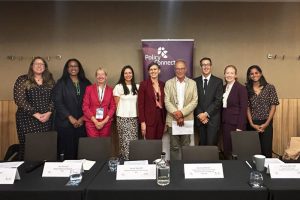
Later that day, Policy Connect, in partnership with Bayer, hosted Making Every Contact Count: Improving Women’s Long-Term Health.
Co-chaired by Dr Simon Opher MP and Jessica Toale MP, the panel brought together Baroness Gillian Merron, Minister for Women’s Health and Maternity; Tara Phaneuf; Dr Veline L’Esperance; Alison Wright; Alex Kenney; Professor Rob Waterson; Lavanya Rangarajan of Policy Connect; and Dr Stephanie Cook.
The discussion explored how national commitments on women’s health can be translated into measurable improvements in care, with a particular focus on prevention, earlier diagnosis and better use of routine interactions with the NHS.
Five key themes emerged: using routine NHS contacts, including screening and testing, as opportunities for earlier detection; addressing the underrepresentation of women in clinical and pharmacological research; tackling structural barriers that hinder timely access to care for women; using better data and patient feedback to improve equity; and improving commissioning so that care shifts towards prevention and earlier intervention.
As Policy Connect’s Lavanya Rangarajan said:
“Women are still underrepresented in the trials that shape their own treatments. If we want more equitable outcomes, we need more equitable evidence too. Otherwise, the care we design for women will only ever be as good as the skewed picture on which it is based.”
The discussion highlighted that improving women’s long-term health will require not only new policy commitments, but stronger implementation, better data, and a greater focus on prevention throughout the health system.
Read our recent report on improving access to primary care here: https://policyconnect.org.uk/report/first-point-of-care-a-plan-for-a-better-nhs-front-door-through-connected-primary-care/
For more information, please contact Lavanya Rangarajan at lavanya.rangarajan@policyconnect.org.uk.
Conservative Party Conference: Building a More Accessible Transport System for Disabled People
On 4 October, Policy Connect returned to the topic of accessible transport at the Conservative Party Conference.
Chaired by Dr Emma Partlow, Chief Executive of the national centre for accessible transport (ncat), the panel brought together Lord Daniel Moylan, Shadow Minister for Transport; Bob Blackman CBE MP; Clive Gilbert, Head of Accessible Transport at Policy Connect; James Windsor-Clive, Chair of the Conservative Disability Group; and Lana Hempsall.
Building on discussions held earlier in the conference season, the panel considered what government, local authorities and industry can do to remove barriers across the transport system and ensure accessibility is embedded consistently in both policy and delivery.
Five key themes emerged: embedding co-design and disabled people in decision-making roles; implementing clearer accessibility standards; improving the availability of information for disabled passengers; recognising the important role of assistive and accessible technology in transport; and ensuring accessible transport enables disabled people to access and sustain employment.
As Policy Connect’s Clive Gilbert said:
“Yesterday’s meeting brought together delegates to share ncat’s evidence on how barriers to accessible transport can be removed, and to discuss what decision makers in government, local authorities and industry can do to make transport work for everyone. While public policy has a crucial role to play in building a more accessible transport system, the meeting also reflected on the importance of culture change within the industry – particularly the need for more disabled people to be employed at all levels of organisations, ensuring that lived experience is fully embedded in their operations, from the boardroom to frontline staff.”
The discussion reinforced the importance of combining effective policy and regulation with cultural and organisational change across the transport sector.

For more information, please contact Clive Gilbert at clive.gilbert@policyconnect.org.uk.
Looking ahead
The 2026 conference season provided an important opportunity to bring together policymakers, practitioners, sector leaders and people with lived experience across a wide range of policy areas.
Despite the different subjects discussed across the five events, several common themes emerged: the importance of designing policy around people’s lived experiences; ensuring support is consistent across different services and stages of the journey; improving collaboration between government, employers and service providers; and translating national policy ambitions into effective delivery.
Policy Connect will continue to use the evidence and perspectives shared during these discussions to inform our work across Accessibility, Education and Skills, and Health.
Over the coming weeks, we will also publish further analysis of key policy announcements made during the party conferences on our website and LinkedIn.
We look forward to continuing these conversations throughout the year ahead, and returning to party conference season in 2027.
 Related content