

 Health
The Government has placed primary care at the centre of its plans to shift care from hospitals into the community, move from analogue to digital services, and strengthen preventative care. Primary care acts as the front door to the NHS and access to it is not only about the speed at which people are seen, but also whether the person seeing them knows their history, whether the care is continuous, and whether their need is ultimately met. However, people across England continue to struggle to access primary care, with the same failures appearing across general practice, community pharmacy, NHS dentistry and optometry. Meeting the Governments ambitions will therefore depend upon strengthening these measures of care to ensure equitable access across the sectors.
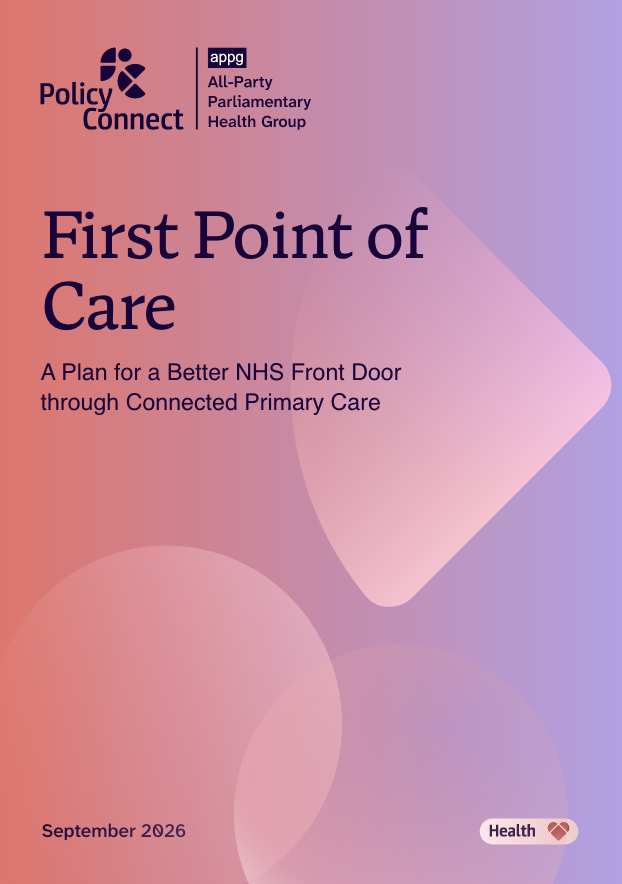
Cross-party think tank Policy Connect’s latest report, First Point of Care: A Plan for a better NHS front door through Connected Primary Care, examines why people in England struggle to access primary care and what changes are needed to overcome these barriers. It is the first Inquiry of its kind to examine all four primary care sectors together, recognising that patients do not experience general practice, community pharmacy, NHS dentistry and optometry as four separate systems.
First Point of Care, published on 9 September 2026, follows a cross-party Inquiry led by the All-Party Parliamentary Health Group and chaired by Dr Simon Opher MP, Lord Kamall of Edmonton, Jess Brown-Fuller MP and Sadik Al-Hassan MP. The Inquiry draws on evidence from across the health system, including professional bodies, patient organisations, academic institutions, NHS providers, and voluntary and community organisations.
The report identifies five key findings. Funding is distributed in ways that do not follow need. Community pharmacy, NHS dentistry, and optometry have the weakest foundations. Clinicians are trained and then not commissioned to work. Organisations outside the NHS are already reaching people primary care does not. And the experiences that patients described matches what the inquiry found: registration failures, fragmented care, unmet need, and national measures that count only the people who were seen.
The Inquiry identified that further reform of primary care services in England must be underpinned by a fundamental shift in how NHS resources are allocated. Government should consider how best to deliver on its commitments to rebalance funding towards primary care and care closer to home, through the redeployment of existing NHS spending and away from acute hospital care. Primary care currently accounts for around 8 per cent of NHS funding, compared with around 43 per cent for acute hospital care. The following 13 recommendations set out the practical steps government can take to deliver this shift and strengthen primary care and improve access.
The report sets out 13 practical recommendations for government to strengthen primary care and improve access. Seven of the recommendations can be implemented within existing resources and redeployment of funds. Three can be primarily funded within existing resources, while a final three require additional funding and investment to tackle the issues they seek to address:
- Establish a primary care access standard covering all four sectors and extend measurement to populations currently missing from access data.
- Improve primary care access for underserved populations, including by making inclusive registration standard practice.
- Preserve the local patient voice function and ensure it has a clear route into commissioning decisions.
- Mandate open data standards across primary care and the wider health and social care system.
- Establish a safe adoption framework for new technologies in primary care.
- Expand NHS App and NHS website functionality across all four sectors, alongside a guaranteed non-digital route.
- Establish a Primary Care Investment Standard and reform funding distribution in general practice and community pharmacy.
- Create an integrated commissioning framework across all four primary care sectors.
- Reform the primary care estates architecture and establish a capital investment programme when additional funding becomes available.
- Train, employ and retain the primary care workforce across all four sectors.
- Pair neighbourhood health implementation with a workforce plan and a matching capital plan.
- Enable community anchor institutions to complement existing primary care provision.
- Establish a primary care partnership architecture with continuity of care as a founding principle and a guaranteed primary care voice on every Integrated Care Board.
Simon Opher MP, Inquiry Co-Chair said:
“As Chair of the All-Party Parliamentary Health Group, and as a GP who has spent thirty years in the NHS, I am proud to present the Group’s first major report in several years, and to present it on a subject that matters to every constituency in the country.
When I was knocking on doors before the election, the most common thing constituents raised with me was that they could not get an appointment. That is what brought me to this inquiry, and over the past year we have heard from patients, professionals and researchers across general practice, community pharmacy, dentistry and optometry. Patients do not experience these as four separate services. They experience them as the front door to the NHS. That is why this inquiry looked at all four together, and why our recommendations are addressed to the system as a whole rather than to one part of it.
The recommendations here are practical and deliverable. I look forward to working with colleagues across Parliament to see them delivered.”
Lord Kamall of Edmonton, Inquiry Co-Chair said:
“I joined this inquiry to find solutions that could win some cross-party support to improve access across the whole of primary care., i.e. GP surgeries, dental care, pharmacy and optometry. It has done exactly that, drawing on evidence from across the sector and, importantly, from patients themselves.
As a former Health Minister with responsibility for technology, I have long argued that patients should no longer have to ring at eight in the morning in the hope they get through, and that given the existing technology around us we need to move away from a 1940s model of seeing a GP only to be effectively triaged to a pharmacy or to a hospital.
This inquiry has looked closely at the barriers to change, and where the real opportunity lies. Much of it comes down to whether the different parts of primary care can share information about the patient in front of them, while addressing concerns over data privacy. This report identifies those barriers and sets out what could be improved – including recommendations that require no additional expenditure – to give decision-makers practical proposals to consider.
I hope that Ministers and parliamentarians across both houses will engage with the recommendations.”
Jess Brown-Fuller MP, Inquiry Co-Chair said:
“I joined this inquiry because my constituents, like people across the country, are struggling to access the care they are entitled to. Taking part in this inquiry has shown me that the people worst affected are often the ones we hear from least.
What is clear is there are far too many people struggling to get a GP appointment when they need one, leaving them waiting anxiously for the care they deserve. This has had terrible consequences for people’s health and for the NHS. It can lead to important diagnoses being missed or delayed, and can force desperate people to call an ambulance or take themselves to A&E.
Following this report’s publication, I will continue pressing the Government to get a grip of primary care.”
Sadik Al-Hassan MP, Inquiry Co-Chair said:
“As Co-Chair of this inquiry, and having spent nearly two decades as a pharmacist, I have seen what primary care can achieve when the different parts of it are able to work together. This inquiry set out to understand how to make that the norm rather than the exception.
One of the most encouraging findings is how much capacity is already there. Pharmacists are qualifying as prescribers in growing numbers. Optometrists have equipment in their practices that can pick up disease early. In both cases the skills and the technology are in place, and what is missing is the route by which the NHS asks them to be used. What the report identifies is how to connect that capacity to the patients who need it, and there is real opportunity here for a Government looking to move care closer to home.
I look forward to working with colleagues across the House to turn these recommendations into action.”
Jasmin Adebisi, Senior Policy and Research Manager at Policy Connect and lead researcher said:
“Over the past year, this inquiry has brought together patients, healthcare professionals, sector representatives, researchers and parliamentarians to look at primary care differently – not as four separate sectors, but as a connected system that should work around the needs of patients.
The evidence showed us that good access is about much more than how quickly someone can get an appointment. It is about reaching the right care, being able to navigate services, having continuity where it matters, and ultimately getting the help you need.
That is at the heart of First Point of Care. The report sets out a practical, cross-party plan for a better NHS front door through more connected primary care, making better use of the expertise and capacity that already exists across general practice, community pharmacy, dentistry and optometry. We now look forward to working with Government, Parliament, patients and the wider health sector to turn these recommendations into meaningful change.”
This Inquiry was made possible through the support of the Institute of Public Health and Wellbeing at the University of Essex and Primary Health Properties.
If interested in contributing to further work on Health policy, please contact Jasmin Adebisi (jasmin.adebisi@policyconnect.org.uk).


 Related content
 Download report